

Written by: James Hart
Companies face an ever-evolving series of security threats, making contingency planning and preparedness essential. One of the best ways to improve security is by learning from past incidents.
The end of the year is a particularly good time to review the preceding 12 months for potential lessons and strategies that can be incorporated into an organization’s security strategy going forward.
As you prepare your business for the coming year, here are a few of the key points that Chesley Brown, the security consulting and management firm, is sharing with its clients.
1. Good Security Can Act as a Strategic Business Advantage
Forward-looking companies increasingly recognize the importance of security – not just as a line item in the budget, but as a driver of business growth.
Good, consistent security can help prevent significant losses while limiting or preventing downtime, giving businesses a greater ability to outwork and outperform their competitors. This is critical for companies in food production, health care, law and countless other fields. It’s especially important for firms trying to safeguard their intellectual property.
Strong security can also become a differentiator for businesses, a way to set their products and services apart from others. Financial services and cybersecurity tools, for example, stand out if they develop strong track records around protecting users’ information.
2. Businesses Need to Take Executive Security Seriously
Several high-profile violent incidents have underlined the importance of security for C-suite leaders and other key personnel. In most cases, these threats seemed to “come out of nowhere.”
Executives have always faced some degree of risk because of their positions and how visible they are, but it was usually related to theft or corporate espionage, said Kim Meador, the president and CEO of Chesley Brown.
What’s new is the polarization and radicalization in some parts of society. Not only are bad actors more willing to use violence, it’s more difficult to identify specific threats early.
But difficult isn’t the same thing as impossible. Companies can reduce their risk through the use of protective intelligence and planning.
For example, auditing their facilities and their executives’ homes and travel schedules allows companies to spot weaknesses and take necessary precautions. Meanwhile, open source intelligence can provide early insight into online chatter that might indicate the company could be targeted by attackers.
3. Organizations of All Sizes Need to Plan for Security
Because of increased polarization, preparedness is becoming more critical for businesses and properties that haven’t really had to consider it before.
As one example, consider the impact of budget cuts on smaller entities, like local governments and charities. These organizations often have to explain directly to the public that services and programs are being cut back or eliminated. Once-quiet public meetings suddenly become magnets for angry protests and upset patrons.
Smaller organizations might not have the resources of large corporations, but there are still strategies they can adopt to manage their risks. The most essential is performing a security assessment to outline potential threats and building contingency plans for responding to them. Building security into the organization’s budget is also an important step.
4. Organizations May Have to Take More Responsibility for Their Own Security
Across the country, local law enforcement agencies are under increasing pressure. In many cases, they lack the staffing to answer all requests for help immediately. In some jurisdictions, the lowest priority calls, such as those related to low-level property crimes, might not receive a response at all.
“We are already seeing instances of this as some police departments no longer respond to noninjury accidents,” Meador said. “Alarm calls are another area where response is often slower because of limited bandwidth.”
This doesn’t mean that organizations shouldn’t build good relationships with law enforcement or seek their help when appropriate.
However, businesses may be better served if they devote more time to preparedness, trying to decrease the chances of an incident and increasing their ability to handle the immediate response.
5. Armed Security Officers Could Become More Common
Historically, the U.S. population has gone unarmed in most day-to-day situations, but it’s becoming more common for people to carry a weapon when they’re out of the home. While most gun owners act responsibly, the increased presence of weapons in public places can raise the odds of an armed incident.
Though violent crime decreased last year, more businesses and property operators are looking to arm their security officers to deter bad actors and defend employees and visitors.
“Historically, most businesses have relied on law enforcement to provide the response to significant incidents,” Meador said. “But with the constraints on law enforcement and longer response times, the private sector is showing more interest in having their own armed security officers.”
6. Companies Need a Strategy for Finding the Signal in Online Noise
What people say online can have a real-world impact, but following the flood of social media posts, Yelp reviews and other messages can be daunting for the average business. It’s even more challenging to tell the difference between a disgruntled customer and someone who’s planning to commit violence.
“There’s so much more noise there,” Meador said, “and there are so many more ways that someone can reach you from the other side of the country, whether that’s through email, a Yelp review or a phone call. Filtering through the noise to understand the real threats? That’s a much bigger lift now.”
Fortunately, firms like Chesley Brown will monitor and analyze open source intelligence – which encompasses, but isn’t limited to online chatter – to identify threats early.
This type of service can not only benefit an organization’s physical security, it can also help protect its brand and reputation. The analysis could uncover complaints about a company’s products or services that might not be recognized otherwise, allowing the company to fix the problem.
7. Your Security Planning Should Encompass Your Supply Chain, Too
The pandemic showed how reliant so many organizations are on supply chains – and how vulnerable those systems are to disruption. Cargo theft in particular is becoming a more pressing problem as shipments make their way from port to port and warehouse to warehouse.
Organizations should make sure their security audits and contingency planning cover the different links in these chains, highlighting potential gaps so they can be mitigated.
For smaller companies, this might feel daunting because they lack the in-house expertise. One solution is working with a fractional chief security officer (CSO) who can suggest practical solutions.
8. New Technology Is Offering More Options for Addressing Security Threats
If businesses and property managers are dealing with new problems, they’re also starting to adopt new tools and technology for resolving those issues.
“Fortunately, there are a number of technologies that are getting smarter and smarter every day that are available to help,” Meador said.
Some examples include:
- New AI-powered systems promise to flag potential shoplifting incidents and quickly alert store staff.
- Other AI systems are being used to identify individuals who appear to be carrying weapons.
- Autonomous security robots can act as a force multiplier for security officers, patrolling parking garages and other large areas more efficiently.
9. Setting Up Internal Controls Could Help Defend Against Major Losses
Some of the biggest, most expensive losses emerge from internal threats, such as embezzlement or theft of intellectual property. That’s why more companies are dedicating resources to internal controls.
That includes splitting up responsibilities for authorizing, executing and reviewing payments, as well as controlling access to files and implementing regular reviews of financials, so that no single person can manipulate the record. New AI-powered analytics tools can also scan records at scale and point out suspicious activity.
But one of the most powerful tactics is encouraging team members to notice and speak up when they spot something.
10. Developing a Safety-First Culture Can Be One of the Most Effective Ways to Reduce Risk
Your team members are in the best position to notice potential safety and security problems before they blow up into something much worse. And when there is an incident, their response could make all the difference between a successful and an unsuccessful outcome.
To encourage the right behaviors during those key moments, organizations should take steps to create a safety-first culture, one where the team is paying attention to security and knows which actions they should take. That includes:
- Developing day-to-day safety procedures and contingency plans that tell team members how to respond
- Training team members on those best practices, and retraining them on a regular basis so the information remains top of mind
- Securing engagement from team leadership, so they will agree to provide the time and resources for training and safety equipment
Learning from 2025, Preparing for 2026 and Beyond
Some of the most important – and painful – lessons come from lived experience. But that’s not the only way to learn the best practices for better security.
Chesley Brown serves a wide array of clients across North America, including large corporations in multiple sectors, property managers for major Class A office towers and complexes, large-scale retail centers, churches, schools and others.
As a result of that broad expertise, the firm can offer expert guidance and support for a range of security needs, including security audits and contingency planning, executive security, protective intelligence and many other areas.
To learn how the firm can help your team strengthen its risk management, contact Chesley Brown today for a consultation with our team.
Sign up!
For industry-leading guides and analysis sign up for our blog below.
Latest News

Spotlight: Bryan Taylor Promoted to Vice President
Chesley Brown Spotlight: Bryan Taylor Promoted to Associate Vice President From Chesley Brown International Employee Spotlight [dpArticleShare] Chesley Brown is excited to introduce our newest Associate Vice President Bryan Taylor. Bryan has been with Chesley…

Spotlight: Christian Kalinski Promoted to Senior Director of Security
Chesley Brown Spotlight: Christian Kalinski Promoted to Senior Director of Security From Chesley Brown International Employee Spotlight [dpArticleShare] We’re always looking to spotlight the amazing work our team does. That’s why we’re so proud to…

An Open Letter on 9/11
An Open Letter on Sep 11th from Managing Director Dell Spry Shared by Chesley Brown International By: Dell Spry [dpArticleShare] They died that day. They woke that morning: showered, dressed, maybe had breakfast, kissed their…

Chesley Brown Announces Counterespionage Unit
Chesley Brown International have announced the formation of a new elite special operations unit, headed by former FBI special agent.

Account Protection with Password Manager
Account Protection with a Password Manager What good is a password if anyone can read it? From Chesley Brown International Risk Management [dpArticleShare] Password managers are not a universal remedy… but can add layers of…
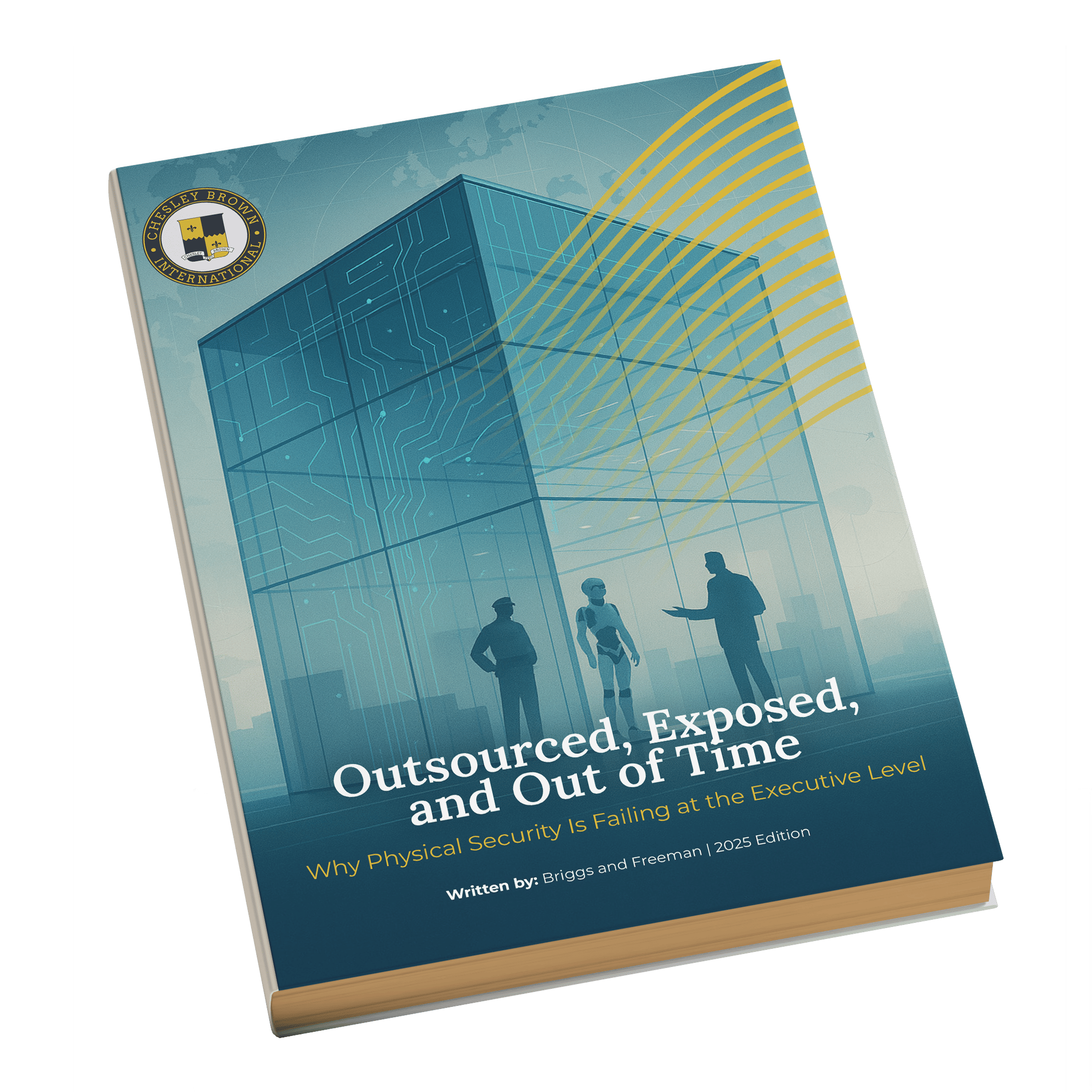
Outsourced. Exposed. Out of Time.
What every executive needs to know about the new threat landscape—and how to respond before it's too late.
This paper reveals why the traditional guard model is collapsing—and how foreign-owned vendors are putting U.S. enterprises at risk. Get the full breakdown of how to audit your vendor stack, modernize your access control, and de-risk your real estate portfolio.
"*" indicates required fields
Outsourced. Exposed. Out of Time.
Outsourced. Exposed. Out of Time.
What every executive needs to know about the new threat landscape and how to respond before it's too late.
This paper reveals why the traditional guard model is collapsing, and how foreign-owned vendors are putting U.S. enterprises at risk. Get the full breakdown of how to audit your vendor stack, modernize your access control, and de-risk your real estate portfolio.
"*" indicates required fields