

Written by: Max Briggs
Physical security used to be a straightforward operational line item—gates, guards, cameras, and access control. Today, it’s a board-level function tied directly to risk, resilience, tenant satisfaction, and enterprise value.
Organizations with complex footprints—commercial real estate portfolios, mixed-use developments, logistics hubs, healthcare campuses, and corporate offices—are experiencing threats that move faster, cut deeper, and demand far more precision than traditional models can deliver.
At the same time, executives face rising costs, pressure to demonstrate ROI, and the challenge of recruiting and retaining skilled security professionals in a highly competitive labor market.
This article distills the essential insights for leaders navigating these pressures:
- What to spend and why
- How to conduct risk-aligned assessments
- The role of protective intelligence
- How workforce investment improves both safety and financial outcomes
- Where security programs deliver measurable return
The New Baseline: Security Budgets and Market Trends
Physical security is no longer a side-conversation in facilities meetings—it is a rapidly expanding global industry expected to exceed $147 billion in 2025, driven largely by enterprise-level adoption of integrated platforms, AI-enabled analytics, and multi-site monitoring.
What organizations are spending:
- Large enterprises commonly invest 10–13% of their IT or facilities budget into physical security.
- SMEs typically sit between 5–9%, but their spending is rising quickly due to escalating threats and increased reliance on modern surveillance, mobile access, and cloud-connected solutions.
- More than 70% of organizations are increasing their physical security spend this year, with priority going to unified access systems, smarter analytics, and platforms capable of supporting complex, multi-asset portfolios.
Benchmarks matter—but only as a starting point.
Why Benchmarks Alone Don’t Tell the Full Story
Every asset has its own threat landscape. A logistics hub has a different risk profile than a mixed-use tower. A healthcare campus faces different exposures than a corporate headquarters.
This is where individualized risk assessments become indispensable.
A meaningful assessment should:
- Identify vulnerabilities in transitional areas (parking decks, lobbies, loading zones, skyways)
- Map digital-physical touchpoints (mobile access, visitor management, IoT sensors)
- Evaluate existing technology performance
- Analyze incident patterns and environmental factors
- Produce a defensible ROI model linked to operations
Case Example
A multi-tenant office complex struggling with minor but recurring incidents faced pressure from high-value tenants seeking tighter controls. After a detailed assessment—one that included tenant interviews, site mapping, and data review—management implemented advanced detection tools and flexible mobile access controls.
The result?
Higher tenant satisfaction, improved detection capability, and a demonstrably safer environment across diverse user groups.
Protective Intelligence: From Optional to Essential
Threats today don’t appear out of nowhere. They build slowly—often online—and eventually surface in the physical environment.
Modern executive teams cannot rely on cameras and patrols alone. They need protective intelligence: the proactive collection, analysis, and interpretation of risk signals derived from social media, dark web data, behavioral indicators, access logs, and on-site activity.
Consider the executive threat landscape:
Fortune-level CEOs now face thousands of direct threats in short time windows. Many originate digitally—doxxing attempts, online harassment, leaked travel schedules—before escalating into physical risks.
Protective intelligence enables early detection, rapid decision-making, and interventions before an incident reaches a workplace, event venue, or residence.
Scenario
A manufacturing firm confronted repeated threats tied to a former board member. A protective intelligence program that included background research, digital monitoring, travel pattern analysis, and on-site counter-surveillance provided actionable insight. The organization stabilized quickly, and leadership continuity was restored.
Workforce Excellence: Why Talent Quality Outperforms Headcount
One of the biggest misconceptions in the industry is that risk exposure is solved by adding more “boots on the ground.”
In reality, talent quality matters far more than raw staffing numbers.
When organizations invest in competitive compensation, they see benefits that cascade through both safety and operational performance:
- Lower turnover: Experienced officers stay longer, reduce onboarding cycles, and drive down incident rates.
- Higher skill and professionalism: Officers who understand the property, the tenants, and common risk patterns function as real-time intelligence assets—not just responders.
- Budget stability: Organizations that reduce churn and claims often redirect savings into better training, technologies, and long-term improvements.
In major markets, projected average pay for 2025–2027 reinforces the need for competitive wages. Skilled officers—especially command center operators, console staff, and supervisors—are commanding higher rates based on technological skill, public interaction, and compliance responsibilities.
Investing in talent is one of the highest-leverage decisions a C-suite can make.
Emerging Threats Demand Integrated Approaches
Modern risks don’t respect boundaries. Cyber and physical attacks now overlap; doxxing can lead to real-world targeting; protests, insider threats, and digital reconnaissance can converge at a single asset.
Executives should focus on four pillars:
1. Street-to-Suite Integrations
Mobile credentials, access logs, cloud-connected surveillance, and incident workflow tools must function as one ecosystem—from parking garage to elevator to office suite.
2. Occupant Emergency Planning
Mixed-use sites, multi-tenant buildings, and large campuses require jointly developed evacuation, communication, and response protocols.
3. Unified Analytics
Pulling video analytics, access logs, guard activity reports, and external threat feeds into one view enables dynamic risk scoring and smarter resource allocation.
4. Fractional CSO Services
Many asset owners don’t need a full-time CSO—but they do need expert oversight, compliance guidance, and emergency leadership.
Fractional CSO services deliver enterprise-grade intelligence and strategy at a significantly reduced cost.
Demonstrating Physical Security as a Value Generator
For the C-suite, it is essential to quantify the return on security investments.
Examples of measurable security ROI include:
- Reduced incident frequency and severity
- Lowered insurance premiums and claims
- Higher tenant satisfaction and retention
- Fewer operational disruptions
- Stronger brand reputation and trust
Simple ROI Illustration:
If a $10,000 upgrade reduces major incidents from 20 per year to 5 (with an average loss of $1,500 per incident), it pays for itself within a year—not including the hidden gains in tenant satisfaction, reduced liability, and continuity.
Security is no longer a pure cost. It is a value-creation engine.
What Executives Should Do in 2026
1. Benchmark — but validate with real risk data
Use industry benchmarks to frame budgets, then adjust based on actual vulnerabilities, tenant expectations, and operational realities.
2. Prioritize workforce excellence
Paying for skill and retention is cheaper than funding losses, turnover, and inefficiency.
3. Adopt intelligence-driven security
Protective intelligence should inform decisions before, during, and after incidents.
4. Connect security to tenant experience and brand reputation
Safe, well-managed environments command higher occupancy and lease premiums.
5. Unify systems for better data and outcomes
Integrated video, access, and alarm data produce insights siloed systems cannot.=
Final Thought for the C-Suite
Physical security is no longer an operational afterthought—it is one of the most reliable levers executives have to protect revenue, enhance resilience, and elevate asset value.
Organizations that lead with data, intelligence, talent, and executive engagement will not only weather emerging threats—they will establish a long-term competitive advantage.
Sign up!
For industry-leading guides and analysis sign up for our blog below.
Latest News

DHS and Canada Team up for First Responders
DHS and Canada Team Up to Develop Resources for First Responders From Chesley Brown International Risk Management [dpArticleShare] Artificial Intelligence Meets Boots on the Ground to Improve Patient Outcomes The United States and Canada have…

Supreme Court Decision Regarding the Privacy of Digital Data
Supreme Court Decision Personal Rights and the Expectation of Privacy in the Digital Age From Chesley Brown International Risk Management [dpArticleShare] In Major Privacy Case, Court Rules Law Enforcement Must Obtain Warrant To Track Cellphone…

The Evolution of School Security
Special E-Brief June 2018 In the current climate of school shootings, we have anguished over the potentials that may follow the ongoing rise in active shooter and other critical events in schools everywhere. There is…

Threats Our Kids Face Online
Protecting Our Children Against Online Threats Teaching our kids to be wary online Chesley Brown E-Brief May 2018 From Chesley Brown International Risk Management [dpArticleShare] Cyber bullying and cyber-predators are real online threats to our…

10 Steps for Developing An Emergency Response Plan
The Property Manager’s Guide to Risk Management From Chesley Brown International Bomb Threats and Suspicious Packages The recent bombing incidents in and around Austin, Texas serve as an unfortunate reminder that those responsible for all…
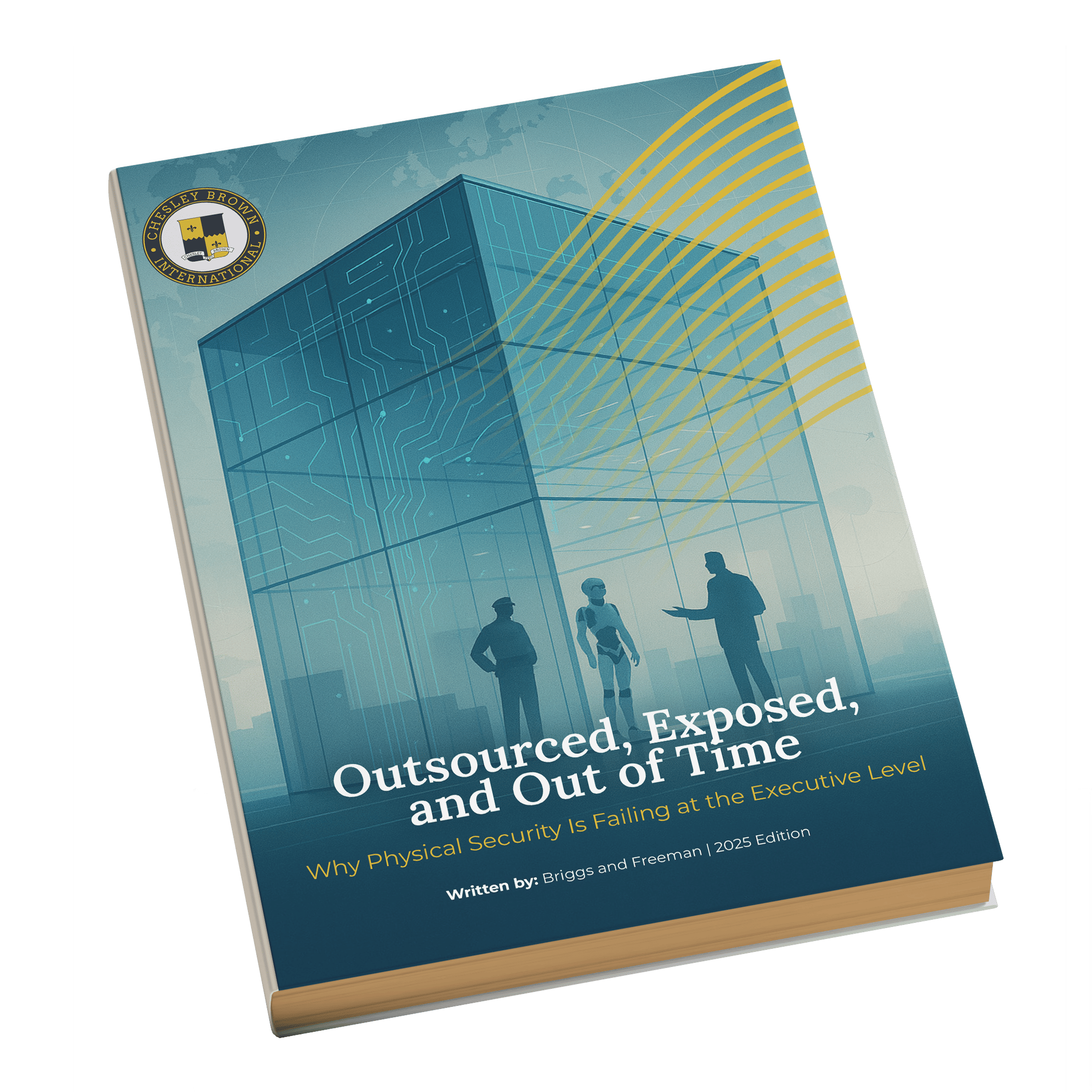
Outsourced. Exposed. Out of Time.
What every executive needs to know about the new threat landscape—and how to respond before it's too late.
This paper reveals why the traditional guard model is collapsing—and how foreign-owned vendors are putting U.S. enterprises at risk. Get the full breakdown of how to audit your vendor stack, modernize your access control, and de-risk your real estate portfolio.
"*" indicates required fields
Outsourced. Exposed. Out of Time.
Outsourced. Exposed. Out of Time.
What every executive needs to know about the new threat landscape and how to respond before it's too late.
This paper reveals why the traditional guard model is collapsing, and how foreign-owned vendors are putting U.S. enterprises at risk. Get the full breakdown of how to audit your vendor stack, modernize your access control, and de-risk your real estate portfolio.
"*" indicates required fields